Overview
Twelve Ni-rich cathodes, and every argument about them is about where the nickel goes. Charge balance puts up to 0.15 Ni\(^{2}\)⁺ per formula unit in them, the ion that slips into the lithium layer; X-rays see that nickel, but cannot tell it from manganese. Neutrons can, by sign.
Fadila El Kouihen's thesis (UM6P, defence on 4 November 2026; supervisors Abdessamad Faik and Mohamed Chakir) made cobalt-low NCA and cobalt-free NMA cathodes by co-precipitation, doped them with Mn, Fe/Sb, Mg, Y, La, Sc and Na, tested them in liquid cells and, coated with \(\mathrm{LiNbO_{3}}\), in all-solid-state cells. Its structural results come from laboratory X-rays: cells and an intensity ratio used as a proxy for Li/Ni mixing. This site re-reads the thesis's crystallography, sets out the questions it leaves open, computes which probe can answer each, and turns them into proposals to the ILL and the ESRF: a joint project of UM6P (A. Faik) and EHU (I. Urcelay-Olabarria, J. M. Igartua), companion of the garnet-electrolyte project llzo-neutrons.
What the thesis did·The open questions·What each probe sees·The 12 cathodes as structures·The proposals·Instruments
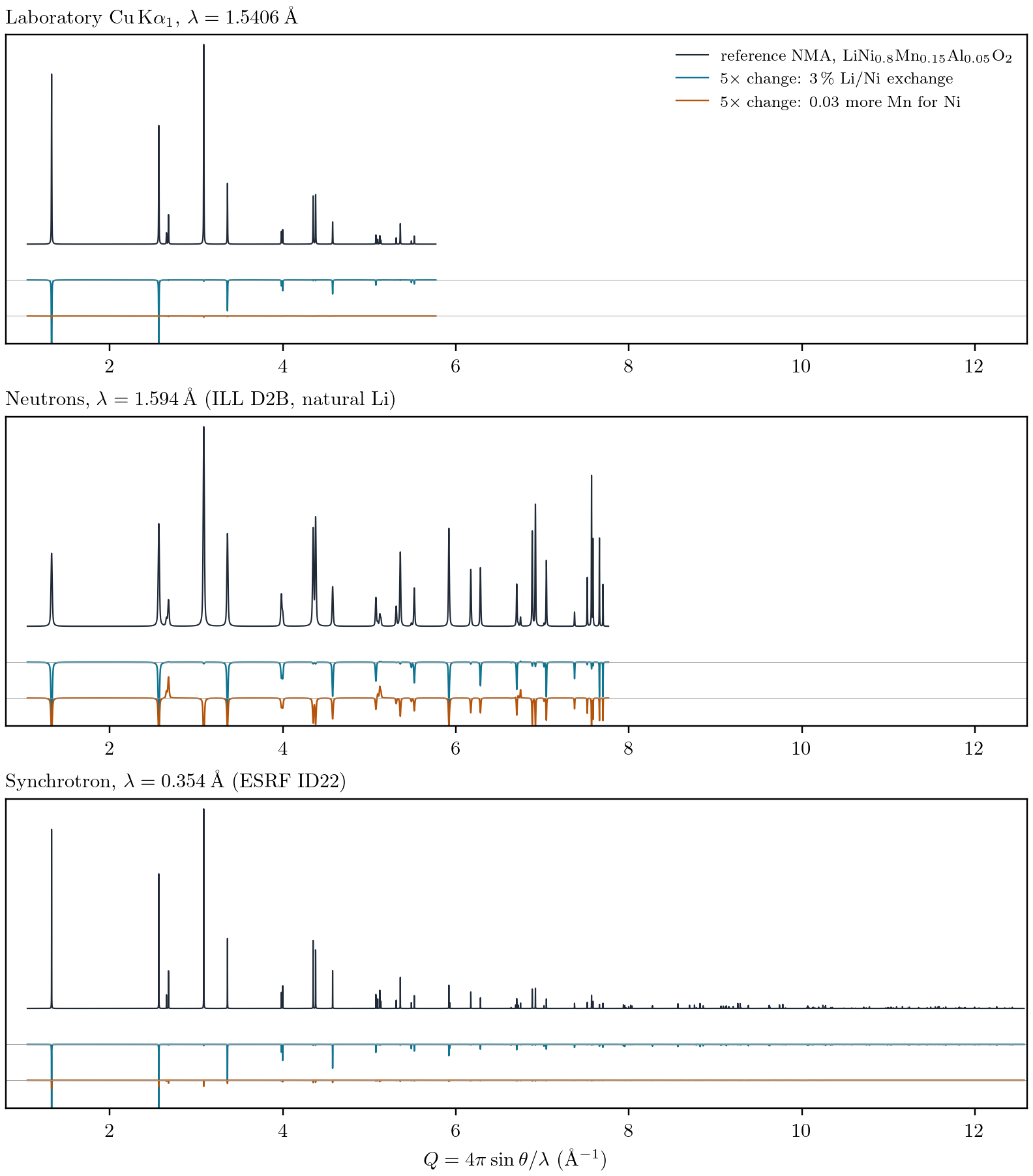
The mixing is seen by both; the metal is seen by neutronsEach structural question computed for three probes before any beam time is asked for
Two models that differ by one question, their patterns computed with diff-ref-struct for a laboratory diffractometer, for ILL D2B and for ESRF ID22. A 3 % Li/Ni exchange changes all three patterns alike, by about 6 %: nickel is heavy enough for X-rays. But which metal sits in the lithium layer, nickel or manganese, and how Mn, Co and Ni share the metal layer, are 33 to 40 times more visible to neutrons, because manganese scatters neutrons with a negative sign. Oxygen is 2 to 2.5 times more visible. The heavy dopants (Sb, Y, La) are X-ray questions; valences need X-ray absorption. So the project is neutrons, synchrotron diffraction and EXAFS, each where its contrast is, refined together.
The path, in four steps
What was made, how, and what was measured; the crystallography claim by claim; the twelve materials with every number the thesis gives, in one fact base.
Ten structural questions: where the nickel is, how much lithium there is, the metal layer and the Ni valence, the dopants' sites, Fe and Sb, oxygen, the cell, phase purity, cycling, the coated cathode.
For each question, how much the powder pattern changes in X-rays and in neutrons, computed with the app's core. The division of the work between probes follows from it.
The work at home the proposals need, four beam-time proposals with samples, requests, expected results and deadlines, the instruments, the calendar.
The reference cathode, seen by three probes
The contrast page →