Overview
Thirty-eight garnets, and every argument about them is about lithium. In the X-ray patterns they were refined against, lithium carries 0.4 % of the scattering; in neutrons, lithium and its oxygens carry 57 %.
Zakaria Kharbouch's thesis (UM6P, defended on 3 November 2026; supervisors Abdessamad Faik and Mohamed Chakir) built two families of tri-doped Ga-stabilised LLZO electrolytes, Ga–M–Ta and Ga–M–Sc with M = Ba, Rb, Y, and reached 1.04 mS \(\mathrm{cm}^{-1}\). Its structural results come from laboratory X-rays: lattice parameters and phase fractions, no site occupancies. This site re-reads the thesis's crystallography, sets out the questions it leaves open, computes which probe can answer each, and turns them into proposals to the ILL and the ESRF: a joint project of UM6P (A. Faik) and EHU (I. Urcelay-Olabarria, J. M. Igartua).
What the thesis did·The open questions·What each probe sees·The 38 garnets as structures·The proposals·Instruments
Not everything is a neutron questionEach structural question computed for three probes before any beam time is asked for
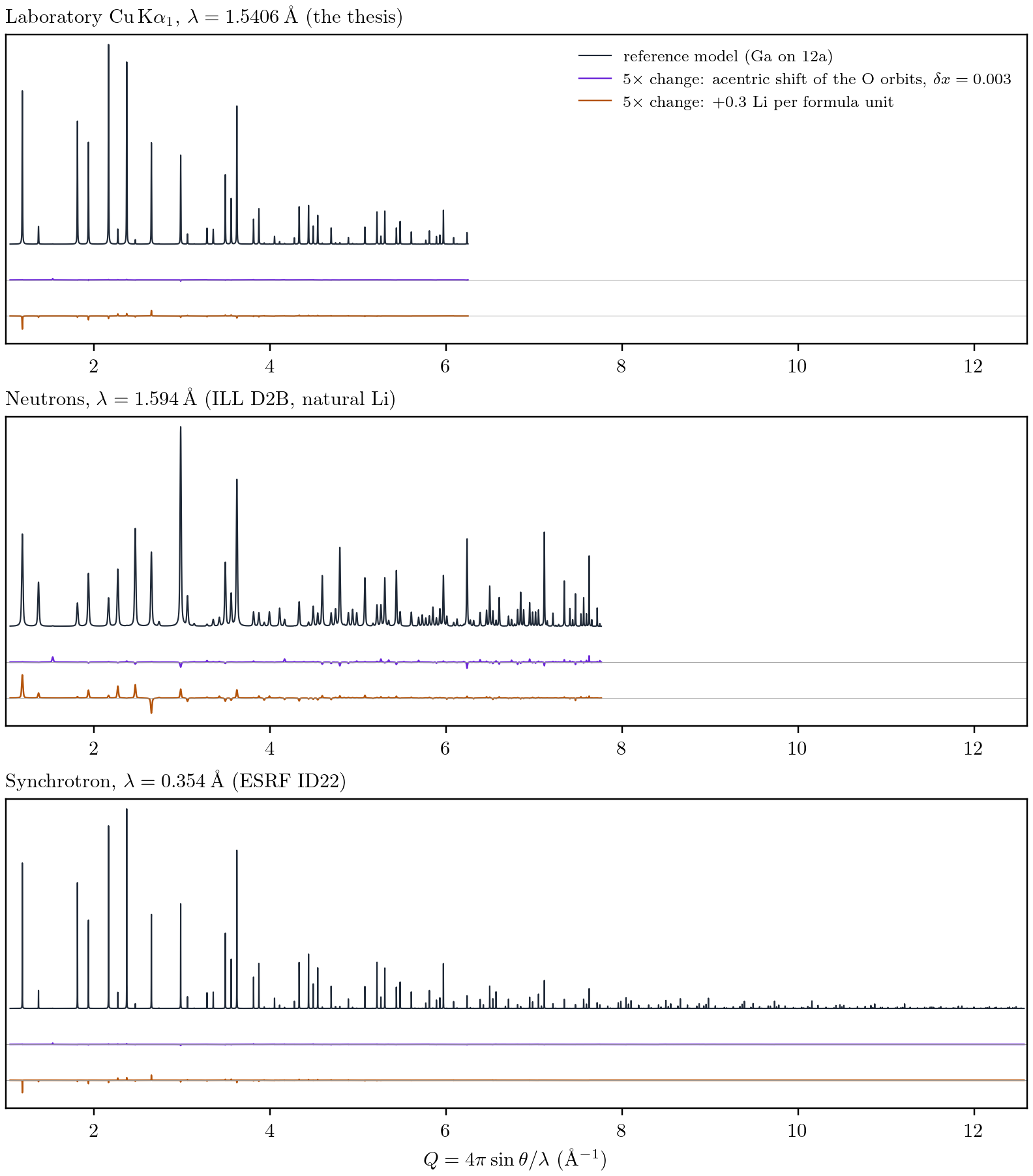
Two models that differ by one question, their patterns computed with diff-ref-struct for the thesis's laboratory diffractometer, for ILL D2B and for ESRF ID22, and the change measured. Neutrons win every lithium question (content, distribution, aluminium, protons: 2–4 times), the acentric distortion that makes the garnet \(I\bar{4}3d\) (9 times) and barium on the lanthanum site (12 times). X-rays win yttrium and rubidium on the lanthanum site, tantalum and scandium on the zirconium site. Yttrium on the zirconium site, on which the thesis builds the explanation of its best composition, is invisible to every powder probe: it needs X-ray absorption spectroscopy. So the project is neutrons, synchrotron diffraction and EXAFS, each where its contrast is.
The path, in four steps
What was made, how, and what was measured; the crystallography in detail, claim by claim; the 38 compositions with every number the thesis gives, in one fact base.
Eleven structural questions the laboratory data cannot settle: where Ga and Li sit, how much Li there is, Al from the crucibles, where Y goes, the phase fractions that do not close.
For each question, how much the powder pattern changes in X-rays and in neutrons, computed with the app's core. The division of the work between probes follows from it.
The work at home the proposals need, and four beam-time proposals with samples, requests, expected results and deadlines; the instruments; the calendar.
The reference garnet, seen by three probes
The contrast page →