Figure 6.8 · Thesis 4 · Orayech 2015
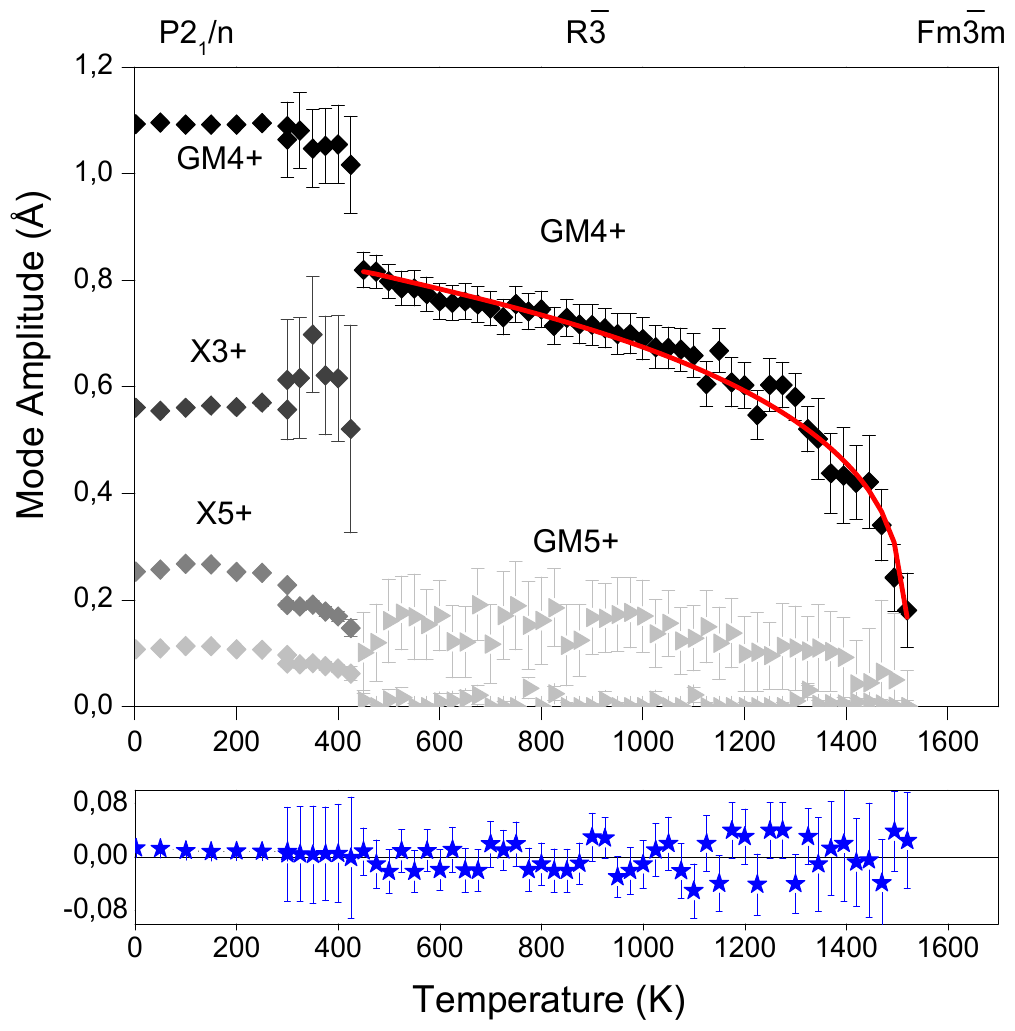
Temperature evolution of the amplitudes of the modes breaking the symmetry from the cubic to the P 2_{1} / n and R \overline{3} symmetries, as obtained from the NPD ( 2-300 \mathrm{K})and XRPD (300-1600 K) data refinements. The \mathrm{GM}_{4}^{+}, \mathrm{X}_{3}^{+}, \mathrm{X}_{5}^{+}\left(P 2_{1} / n\right) and \mathrm{GM}_{4}^{+}(R \overline{3}) are the irreps of the symmetry-modes whose presence sets the distortions in the mentioned distorted phases. In the case of the \mathrm{X}_{5}^{+}irrep, in the lowtemperature range, we are showing separately the effectively freed two components of the 3 dimensional sub-space the irrep spans. In the case of the R \overline{3} space group symmetry, we are also showing, dimmed, the two components of the \mathrm{GM}_{5}^{+}irrep: they do not contribute effectively, so the final values of \mathrm{GM}_{4}^{+}for this symmetry correspond to them having been freed alone. The lower part of the graph (blue symbols) shows the relative difference, in the whole temperature range, between the \mathrm{GM}_{4}^{+}values in two refinements: only the effectively acting modes and all the modes freed. The continuos line in red is the fitting of the trigonal \mathrm{GM}_{4}^{+}amplitude values to the equation: A_{G M_{4}^{+}}=A(0)_{G M_{4}^{+}}\left[T_{C}-T\right]^{\alpha}, with the refined values A(0)_{G M_{4}^{+}}= 0.127(8), T_{c}=1523(1) \mathrm{K} and \alpha=0.26(1).
- Document
- Thesis 4 · Orayech 2015
- Figure
- 6.8
- Kind
- rietveld-plot
- Rights
- own
- Reproduce
- not-needed
auto-cropped from the OCR Markdown crop box (stage B); materials and kind to be reviewed in Phase 1
Evidence
- doc:thesis-04 · figure 6.8 · page 118 · OCR line 1526 · thesis-only · crop box: OCR box scaled to the 300 dpi page and fitted to the ink extent