Figure 5.3 · Thesis 4 · Orayech 2015
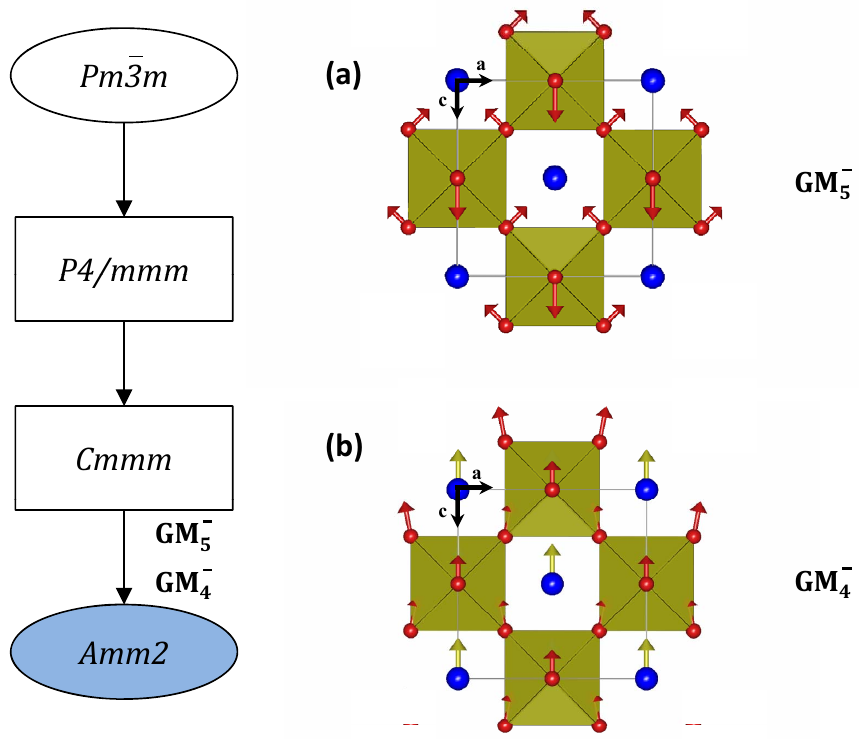
To the left, chain of maximal sub-groups of P m \overline{3} m space group down-to the experimentally observed room-temperature A m m 2 space group. The calculations were completed in the standard setting of the room-temperature space group phase: A m m 2. To the right, scheme of the structural polarization vectors, projected on the x z plane, of the distortion-modes transforming according to the \mathrm{GM}_{5}^{-}and \mathrm{GM}_{4}^{-} irreps, present in the A m m 2 structure. The arrows represent the displacements of the atoms in the modes. The two distortion-modes are identified as necessary in the cubic-to-orthorhombic symmetry breaking.
- Document
- Thesis 4 · Orayech 2015
- Figure
- 5.3
- Kind
- structure-drawing
- Rights
- own
- Reproduce
- not-needed
auto-cropped from the OCR Markdown crop box (stage B); materials and kind to be reviewed in Phase 1
Evidence
- doc:thesis-04 · figure 5.3 · page 78 · OCR line 1063 · thesis-only · crop box: OCR box scaled to the 300 dpi page and fitted to the ink extent