Figure 6.7 · Thesis 3 · Iturbe 2012
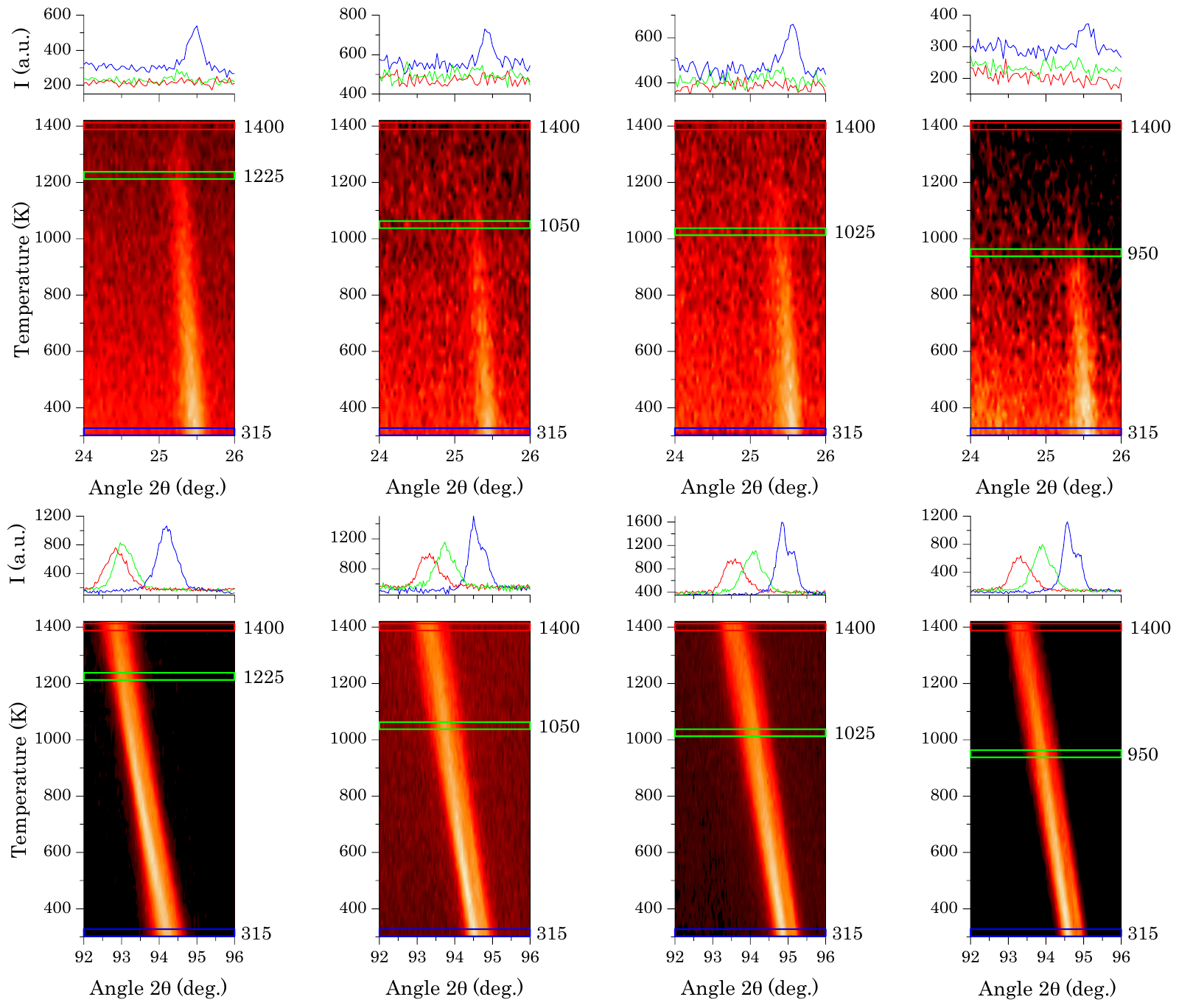
shows the temperature dependence of the laboratory X-ray diffraction profile projections around the ( 111;-111) monoclinic primitive reflections ( 2 \theta=24^{\circ}-26^{\circ}) and (642) cubic reflection \left(2 \theta=92^{\circ}-96^{\circ}\right). The reflections shift to lower 2 \theta positions due to thermal expansion. At low temperatures the monoclinic primitive reflection is clearly seen and disappears at higher temperatures, indicating a phase transition to a non-primitive space group. All compounds undergo a temperature induced structural phase transition taking place at \approx 1225,1050,950 and 1025 \mathrm{K}, \mathrm{SrPrMRuO}_{6}(\mathrm{M}=\mathrm{Zn}, \mathrm{Co}, \mathrm{Mg}, \mathrm{Ni}) respectively. The XRPD experiment was not enough good to determine the new phases’ symmetry.
- Document
- Thesis 3 · Iturbe 2012
- Figure
- 6.7
- Kind
- pattern
- Rights
- own
- Reproduce
- not-needed
auto-cropped from the OCR Markdown crop box (stage B); materials and kind to be reviewed in Phase 1
Evidence
- doc:thesis-03 · figure 6.7 · page 119 · OCR line 1381 · thesis-only · crop box: OCR box scaled to the 300 dpi page and fitted to the ink extent