Figure 5.16 · Thesis 3 · Iturbe 2012
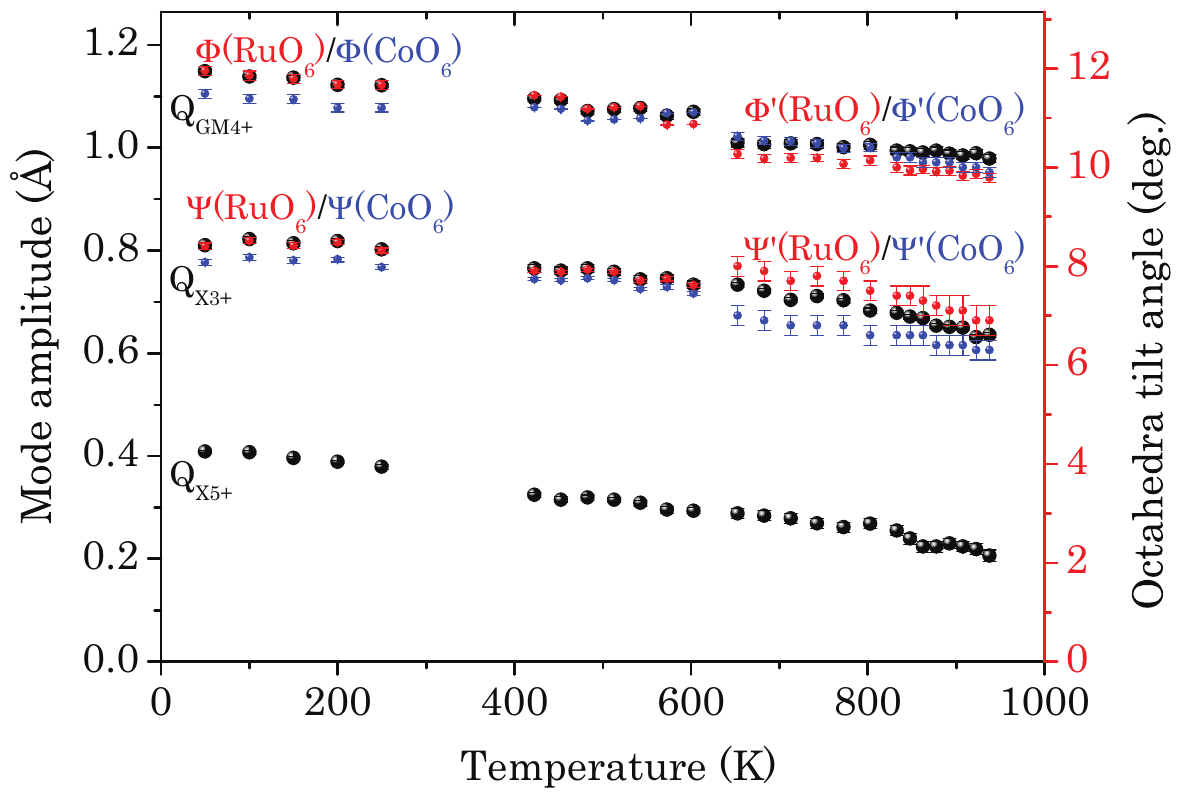
and Table 5.6 exhibit the temperature evolution of the amplitude of \mathrm{GM}_{4}^{+}, \mathrm{X}_{3}^{+}and \mathrm{X}_{5}^{+}modes, the rest are negligible, in the monoclinic and in the tetragonal phases. As mentioned, the physical interpretation of the modes taking part in the symmetry breaking is the tilting of the octahedra. In Figure 5.16 we have also shown the octahedral tilt angles (tilt systems: \mathrm{a}^{+} \mathrm{b}^{-} \mathrm{b}^{-}\left(P 2_{1} / n\right) and \mathrm{a}^{+} \mathrm{a}^{+} \mathrm{c}^{-}\left(P 4_{2} / n\right)). The matching of the mode amplitudes and tilt angles is perfect (Figure 5.8). \mathrm{GM}_{4}^{+}and \mathrm{X}_{3}^{+}modes (rotation and inclination
- Document
- Thesis 3 · Iturbe 2012
- Figure
- 5.16
- Kind
- amplitude-vs-t
- Rights
- own
- Reproduce
- not-needed
auto-cropped from the OCR Markdown crop box (stage B); materials and kind to be reviewed in Phase 1
Evidence
- doc:thesis-03 · figure 5.16 · page 104 · OCR line 1148 · thesis-only · crop box: OCR box scaled to the 300 dpi page and fitted to the ink extent