Figure 12 · Thesis 2 · Faik 2009
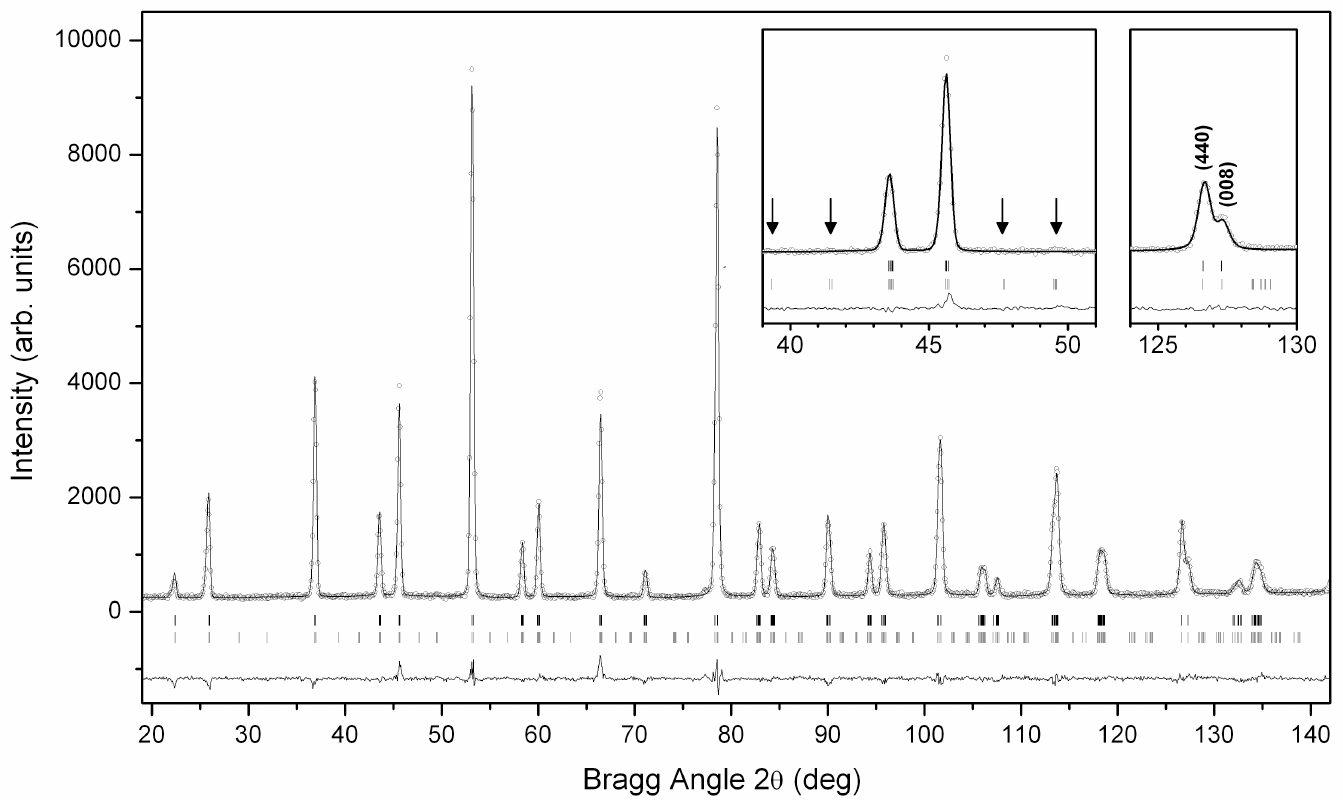
shows the evolution of diffraction intensities of this reflection with temperature. From the profile shape characteristic reflections at 2 \theta from 91 to 96 in (figure 12b), it was concluded that up to 1740 \mathrm{K} \mathrm{Ca}_{2} \mathrm{ScSbO}_{6} does not transform to the tetragonal lattice ( I 4 / m space group) like \mathrm{Sr}_{2} \mathrm{ScSbO}_{6}. This shows that there is no change of the monoclinic distortion in all this range of temperatures; and, analyzing the peak splitting, it becomes clear that at 1740 K the unit cell is monoclinic. After examination of all diffractograms, we observed, about 1440 K (figure 12a), the continuous desapearance of diffraction peaks corresponding to primitive Bragg reflections, with indices (hkl) of the type h+k+l=2 \mathrm{n}+1. This corresponds to a continuous phase transition from monoclinic P 2_{1} / n to monoclinic I 2 / m at about 1440 K. The evolution with temperature, from 720 to 1680 K, of the refined lattice parameters for \mathrm{Ca}_{2} \mathrm{ScSbO}_{6}, are shown in figure 13. As deduced from the figure, the lattice parameters increasing countinuously with temperature, and the difference between \sqrt{2} a, \sqrt{2} b and c lattice parameters decreases. But no anomaly change is noted.
- Document
- Thesis 2 · Faik 2009
- Figure
- 12
- Kind
- rietveld-plot
- Rights
- own
- Reproduce
- not-needed
auto-cropped from the OCR Markdown crop box (stage B); materials and kind to be reviewed in Phase 1
Evidence
- doc:thesis-02 · figure 12 · page 179 · OCR line 1972 · thesis-only · crop box: OCR box scaled to the 300 dpi page and fitted to the ink extent